Under His Wings

This morning, I learned that the 7-year-old son of someone in our group fell 13-feet into a manhole. Miraculously, he escaped with just a few cuts and scrapes.

I am reminded of a similar story that happened to the grandson of a neighbor many years ago. I’ll call him Bob. Bob had been on the town First Aid Squad when a call came in saying that a young boy had fallen from a third floor balcony – twenty or more feet. As Bob was driving, his partner jotted down the address.

“What was that address again?” His partner repeated it, and all the blood drained from his face when he realized that he was headed toward his daughter’s apartment building. “That’s my grandson,” he managed to say even as he left the car and ran to the child who was on the pavement surrounded by neighbors.

“Hey Bud, don’t move. I’m here, we’ll take care of you. Don’t worry.” He fought back the concern that might have shown on his face.

red blue and green bird feather

“Oh Granddad,” the tyke said. “I’m not worried. They already told me I was OK.”

Bob assumed that the neighbors had calmed the child down. His partner arrived with the stretcher and gear. As they lifted him together, his grandson said, “When I was falling, they put their hands under my bottom and said, ‘We’ve got you.’ They were all sparkly.”

Bob looked at his partner to see his reaction, which was a non-committal shrug. Had the child hit his head? There was no blood. What was he talking about? With little Bobby safely in the ambulance, they headed for the emergency room.

Less than an hour later, a doctor came out and spoke to the distraught mother and grandfather. “He’s fine. Barely a scratch. How far did you say he fell?”

“At least twenty feet,” Bob’s daughter told him. “He was playing on the balcony, and must have climbed over the railing to try and get to the neighbor, and suddenly, he was gone!”

“Well, they say God protects fools and children. He’s a very lucky boy!” The doctor patted Bob on the shoulder and turned to walk away.

“Doctor? May I ask you something? My grandson said that when he was falling, he felt someone ‘put their hands under him’ and tell him they had him. Have you ever heard of such a thing?”

The kindly young man smiled. “If you believe in miracles, I think this could be considered one.” When Bob didn’t say anything in response, he continued. “My father was a surgeon. When I was a boy, he would sometimes come home and tell us about things he couldn’t explain. I’ve heard stories directly from close friends, too. We have no answers, so we just accept the possibility that we don’t know everything.”

That little boy could never be convinced that he hadn’t seen angels. Years later, the memory was as vivid as it was on the day of the accident. I imagine that once a person escapes suffering or death, they never again doubt that there is something that intervenes on our behalf in moments of danger.

Back in the 1970s, my best man’s son fell into the frozen lake in his backyard. By the time he was finally pulled out he had been in the frigid water for many minutes and had no pulse. They resuscitated him, but the doctors said he would most likely wind up brain dead. Amazingly, he suffered no damage and went on to be a perfectly normal little boy. Doctors credited hypothermia and the young age of the victim.

Is it luck or is there some rational explanation that prevents a catastrophe from happening in life or minimizes its effects? A classic case is the person who suddenly decides not to get on a flight, or to take another route and later finds he’s avoided a disaster.

Both of my sons have had brushes with death, although I personally have not. In many cases, people say they are changed. My mother told me of her experience as a young woman and it forever changed my viewpoint and set me on a fifty-year search for answers.

When we hear of these occurrences or benefit ourselves and are unable to explain them, we can simply go on as we were and live out our time unmindful of the gift we have been given, or we can be grateful for another chance to complete our life’s work.

We can be protected not only from danger, but from bad decisions or even unscrupulous salesmen. Each morning I do what I call ‘protective work,’ just as I was taught to do as a child. I envision myself and my loved ones surrounded by love, in a kind of bubble of white light. Any time I get into a car, I mentally do the same, not just for myself, but for all I encounter on the road.

At the very heart of these incidents – and surrounding us all – is a force that we cannot see or touch. Some call it the Universe, with a capital “U.” Its presence in our life is not dependent upon following any religion, or even in the belief of a God of any name.

When we recognize that the Intelligence that created the world is all around us, guiding, sustaining and protecting, these little miracles can be a powerful reminder that we are always ‘in the palm of His hand.’

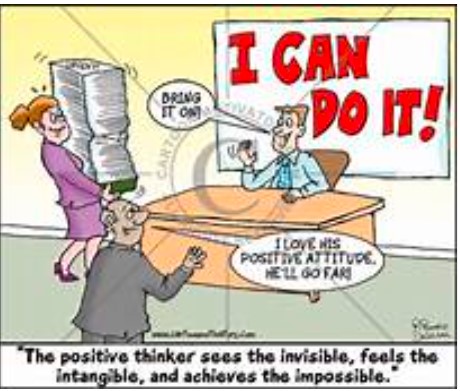
Don’t ever say, “I can’t.”

Our writer’s group recently had a discussion about the lament, “I can’t.”

We’ve all said it, but if it’s truly something we want, we usually do find a way to make it happen. Many people have been inspired to act boldly after being told something is impossible, or they aren’t capable, or no one has ever done it before. The best biographies and stories I have ever read are about people who have overcome limitations and proved their critics wrong.

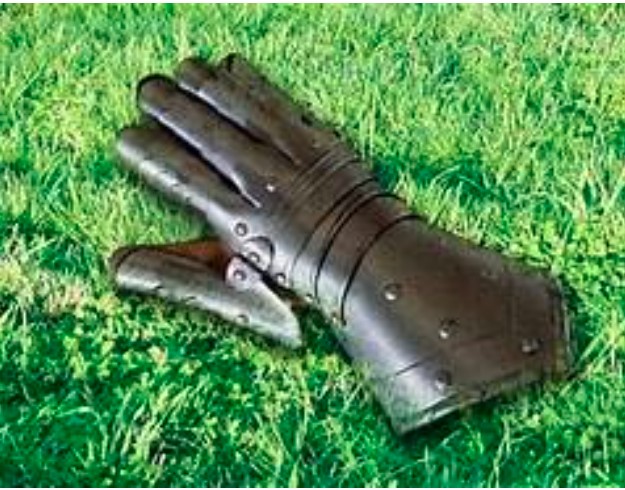
gauntlet

Having someone throw down a gauntlet is often exactly what we need to spur us into motion. Long ago I read about a man with an incredible memory. As a small boy, he overheard his primary school teacher tell his mother he was hopeless, and would never amount to anything. “Your boy can’t read, can’t remember his lessons, and can’t even write his own name properly.”

That fired something up inside him and he vowed to show everyone how wrong that teacher had been. Years later, he became known as Germany’s Memory Man and astounded audiences with his ability to remember every person’s name in the theatre. He was able to quote Tolstoy’s War and Peace in its entirety! Why? Because he told himself over and over that he could.

I’m sure that when my sister reads this, she will recall our mother saying to us, “Don’t say I can’t, say I won’t!

“But that’s not it!” I would argue. “I really just can’t.”

I won't do it

“But why can’t you do it? Is it too hard? Or, don’t you have time?” She paused for effect. “Or don’t you want to do it badly enough?”

I honestly think that my mother was put on earth to be the Tenth Man in my life. In military strategy, when a group of men agree on a plan of action, a Tenth Man is called in to play the part of the ‘Devil’s Advocate. ‘ The contrariness of this person challenges the other nine and incites them to come up with new and even more successful ideas.

Mom waited for me to answer. “You really can do anything, you know,” she said more softly. “It may take more time or money than you’re willing to spend. You may have to find the tools or the energy, but if you want something badly enough, you CAN make it happen.”

I recall thinking at the time that having her challenge me could be a good thing. “So the question is not can I, but will I or won’t I?”

She smiled. “And once you decide, you’ll be surprised how much easier it can be to accomplish your goal than you thought it would be – as long as you don’t get in your own way.”

We often say things about ourselves, our capabilities or our methods that may have been true at one time, but that we don’t want to be true anymore. Almost as if there is a tape recorder running in our minds (I am showing my age), we repeat statements that are no more than habits. Say you’re tired, and you will be. Say you have no energy, and you’ll stay on the couch. Say you can’t do something, and you will not be able to muster up the wherewithal to do it.

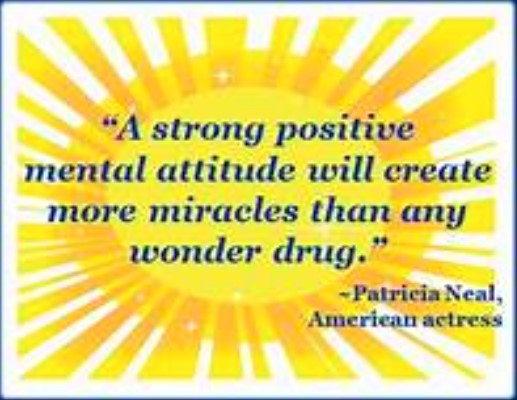
Patricia NealIn the 1960s, my father attended a number of business conferences based on a growing movement called Positive Mental Attitude. PMA, as it was known, promoted the idea that attitude is nine-tenths of the battle. Classics such as ‘Think and Grow Rich,” and “The Power of Positive Thinking,” were often quoted in our home.  I’ve read them each several times.

61MRwKNHNRL._SY438_BO1,204,203,200_One of the most beloved Golden Books of all time was about a little train that showed the advantages of optimism and hard work.  The mantra, “I think I can, I think I can…” is a a phrase many of us will remember from our childhood.  We would do well to ‘take a page out of that book’ and live it! 

“Paris is always a good idea.”

– Quote from Audrey Hepburn

In an earlier blog, I wrote about how important it is to be really specific about the things we want in life. I reiterated how I had always wanted to see Paris with someone I loved, and wound up going with my sister Andrea, which meant I DID get what I asked for. Exactly.

About twenty years later, I found myself planning a trip to France–this time with John. When I met him several years earlier, he was new to the idea of visualization, the Law of Attraction, and manifesting. On the other hand, I had been brought up in a religion that was primarily metaphysical, and all the contemporary New Age gurus such as Wayne Dyer, Louise Hay, Rhonda Byrnes of The Secret fame, were essentially restating what ancient writers had written and what I had been taught since childhood.

At first, John looked at me with the same disbelief I received throughout my youth: “That’s weird. What are you, a witch or something?” But when I began to read passages to him from a newly published book at that time, “Ask and It is Given” by Esther and Jerry Hicks, he began to embrace the idea of taking control of his life by directing his thoughts.

“I’ll SEE it when I BELIEVE it,” was the first hurdle he approached. As he began to discern the difference between repeating  Coué-like phrases and making declarations, he was rewarded with some successes. He was incredulous as little things like parking spaces appeared within seconds of driving to a store entrance; or when a thought occurred to look in an unlikely place for an item he thought was lost, or when answers just ‘showed up’ when he needed it.

“Beginner’s luck,” I teased, but I was also pleased that he was growing away from the purely material way of looking at the world. An oft-quoted phrase by Mary Baker Eddy in our household when I was a child was, “Hold thought steadfastly to the enduring, the good and the true, and you will bring these into your experience proportionately to their occupancy of your thoughts.” As I get older, I realize how true her euphemisms were, even if couched in 19th century prose.

Now, just because I knew about these ideas didn’t mean I practiced them all the time; if I did, I’d probably have everything my heart desires. It seems that after long use of something we often get lazy, and like a relationship gone stale, I began to take metaphysics for granted.

I found myself in that state of mind in Paris.

AudreyJohn and I had a wonderful week driving through the French countryside. We visited Versailles, Amboise, Blois, and the Loire Valley with all its beautiful castles and grounds. Little surprises seemed to be around every corner that delighted the eye and the palate. We met locals and shop owners and families who were so authentic and happy, it made us wish we could stay forever. But of course, that’s what vacations are for–to learn things about other cultures and try to incorporate them into life at home.

As we made our way towards Paris (John, for the first time), we saw a sign for Orleans. John had seen a photo of the quaint little town in a brochure and wanted to visit, but never said anything because he didn’t think we’d have time. But a sign said the Fêtes Johanniques, the festival for Joan of Arc, was taking place that day, and we veered off the A10 toward the celebration. “See John, you put it into your consciousness, and here we are!” I told him, mirroring what my parents had always told me.

That little town turned out to be a big city, and true to form, John found the last available parking space, the one that was closest to the parade route. We marveled at this recurring talent of his and joined in the revelry just as Joan was riding past our spot in the crowd. We followed her and the Mayor in all his pageantry to the beautiful cathedral where the Mayor gave us a private tour.

“This is just like the picture!” he whispered. My eyes found his and we were locked together in that private language that couples in harmony have. It works! he said without speaking. Are you surprised? I silently answered.

We were falling in love with small-town France and wanted to delay leaving it. Paris would be exciting and romantic, but a quick, relaxing dinner (anything less than two hours in France is quick) would nicely finish off our rural escapade. We reviewed all the things we had seen and done, shared a decadent dessert, and were finally ready to head back toward the City of Lights.

colzaThe sun was fading over the fields of colza (rape seed), lavender and tall, slim windmills, and we realized with a dismay that we would never make it to the car rental location before it closed. “No matter,” John said confidently. “We’ll stop somewhere for a map and return the car in the morning.”

Drawing upon my own memories, I envisioned the nightmare of driving in Paris: tight, medieval lanes, one-way streets, cars jammed into spots like sardines and the possibility of getting lost. I got out the little flashlight I had in my bag and searched for our itinerary. “Rick Steves says that some hotels have parking garages, but you have to reserve well in advance.” I realized with dismay that I wouldn’t know how to use the phones, even if we found one.

Eyeing my worried look, John turned his eyes back to the road and answered by quoting a principle he was becoming comfortable with. “What do you always tell me? Don’t bring that negative energy into this.”

I’ll admit, that got my dander up a bit. Who was HE to tell ME about staying positive? He had never heard about the ‘Law of Attraction’ until he met me. He had never been to Paris. I took a deep breath. It was getting late, we were tired, and it had started to rain.

We found a petrol stop with a convenience store where I struggled to make myself understood. In my experience, few people in France speak English outside of the big cities, or perhaps they are just reluctant to do so with Americans. If you at least try to speak their language, they will be very nice.

As I unfolded the map on the front hood to take advantage of the store’s interior light, John walked around the car trying to figure out why everyone had been beeping at us as they passed. “Tell me if the brake lights work.” They did. And so did all the directional signals. “Are you sure?” He pressed.

“Yes, I’m sure,” I said, a little more forcefully than necessary, then added, “They’re a little different from an American car, but they work.” We continued on our way, straining to read the signs through the pouring rain.

We missed our exit off the ring road and had to approach the city center from the North. We found ourselves on a wide boulevard, passing gated shops. Cars were beeping at us and we were clueless as to why. Finally, a driver leaned over at a stop light and shouted that we had our rear high beams on. We had been blinding everyone. John fumbled and found the knob to turn it off. “Merci,” he called to the driver in that sing-song way that the French speak. With the mystery solved, cars stopped honking, and thankfully the rain stopped as well.

Our moment of relief was short-lived. As I drew an imaginary line on the map between where we were and where we wanted to be, I realized we were heading straight toward the Seine and the center of Paris. I had hoped to avoid heavy traffic.

city art paris building

We’ll drive past that big church,” he said nonchalantly.

I eyed him with disbelief. “Notre Dame? You’ll just drive past Notre Dame, in the center of the city, with all the tourists walking around?”

“What’s the big deal?” I kept my mouth closed as we drove over the Rue de la Cite with its beautiful cathedral lit up like a jewel. The sight of it at night took my breath away.

“We’re almost there,” he said triumphantly. “There’s the Opera. We’ll be in our room opening that bottle of wine we bought in Chenonceau within the hour.” Was that just male bravado speaking? I wondered. But he said it with such conviction that I started to believe him. Was I creating the problems with my negative thoughts?

I looked at the clock. It said 8:35. We pre-paid for several nights at the hotel and were assured for late arrival, but as we drew closer to our destination, the streets narrowed and became incredibly confusing. We hadn’t passed a single open parking spot. “Don’t worry,” John said, “I’ll just drop you off at the hotel with the bags, park the car, and then I’ll come back.”

Suddenly, I was recalling the time Andrea and I got lost in Montparnasse after all the buses had stopped for the night. I shudder to think what would have happened if not for a young man who walked us to the street where our hotel was located.

“You don’t understand,” I said with real anxiety in my voice. “If you drop me off, I’ll never see you again! You don’t even speak the language!”

John didn’t answer. He has a calming effect on me when I get wound up and realizes that sometimes it’s best to say nothing. But after driving in circles and coming to the same corner three times in a row, even he was getting frustrated. Suddenly, without warning, he pulled into a residential driveway and shut the car off. I thought he was angry. “I don’t know what to do,” he admitted.

I realized I was caught up in a fear or anxiety ‘loop’–and I was pulling him there with me. A thought occurred to me, ‘Stop Everything and Listen!’ We sat there in silence and waited.

It could have been minutes or only a few seconds later when we were startled by a knock on the window. “Puis-je vous aider?” an older woman dressed all in black asked John.

He rolled down the window. “Oh oui, merci,” I said to the kind lady. Her husband stood nearby. “Notre destination est Hotel Mogador at…ummm… cinquante-et-un Rue de la Victoire.” I had been practicing for just such an encounter.

Ah! L’hotel Mogadar.” And then she rattled off in French a lot of droits and gauches, meaning lefts and rights.

John interrupted. “Do you speak English?” The husband, who had been standing nearby, shook his head and smiled. “Celeste, you’re giving them walking directions!” He proceeded to tell John how to find the hotel.

And then we were on our way. We turned into the correct street and saw the hotel name on the building ahead on the left. “There it is!” I exclaimed. It looked like the city of Oz in the distance.

A moment later, John asked, “Do you see what I see?” I turned my head slightly and watched as a car pulled out of a space right across from the door of the hotel. The hairs stood up on the back of my neck. “I’ll run in and ask if it’s OK to park there and how much it will cost.”

John was removing our bags from the trunk. “We’re good,” I told him, “and no charge after eight PM.”

We checked into our lovely room, set the bags down, and he opened that bottle of wine. I realized I had learned a good lesson from our experience–one that was more important than simply getting lost and finding our way.

John had been adamant when he said he would be able to find a parking spot, and it showed up exactly where he expected at exactly the right time. He believed it, and then he saw it, not the other way around. If we had arrived a minute or two earlier or later, it might not have been there.

It would be easy to say that his advantage was that he didn’t have old memories clouding his optimism, but there was more to it than that. I had a personal lesson to learn. I was thinking that he was practicing the visualization I had taught him. So, I had not only doubted him, I had been haughty and egotistical about it.

the-more-i-learn-of-physics-the-more-i-am-drawn-to-metaphysics-quote-1

The ability to manifest is available to everyone. It is a power that when utilized can make a lot of things in our life much easier. If we remember not to get caught up in our own fears and negativity, and if we ask for what we want in a clear, direct way, when the time is right, our ideas will manifest into our experience.

It’s been over a decade since we went to Paris, but I will always keep this story in my memory to remind me not to become jaded about the power of our thinking – both positive and negative.

Oh, the clock on the bedside table said 9:30 as we sipped our wine. One hour had passed, just as John had envisioned.

This is what ‘being in the flow’ looks like…

A writer – or for that matter, any kind of artist – if s/he is lucky, may occasionally find himself in the throes of a creative power that is so enthralling and powerful that the words on paper, the brush on canvas, or the notes that fill the air take on an ethereal quality.

I’ve been fortunate to experience several of those major transcendent episodes over the course of my life. There is nothing more memorable than being so fully in the moment that your entire being is consumed with the energy of creation. Words flow almost effortlessly as if time stops and personal sense fades away. Every detail is synchronously registered in your body, and yet you may not even be aware of tears that stain your face because you are living a precious moment in the sweet spot of life.

I chanced upon this video today, performed by the popular Croatian cellist from 2CELLOS. It literally transported me into the space in time when I first heard those first few melancholic notes. What an incredible ability the mind has to recreate what it has known from the past when imprinted with emotion.

This is what ‘being in the flow’ looks like.

“Adagio for Strings,” composed by Samuel Barber, is one of my very favorite pieces of classical music. Although it is slow and some may call it ‘depressing,’ it pulls at my heartstrings. Hearing it only once imprinted the notes into my brain over fifty years ago. You don’t have to know the composer, or the name of the piece to be drawn into its soaring, magical world.

As I watch Stjepan Hauser’s face, I can see that he is not just playing the cello, he IS the cello and he IS the music. He is so in tune with his instrument that you can see every note play on his face. With eyes closed, he blocks out the material world and enters the sublime.

The vibrations on the air are the breath of God speaking to man’s soul.
–Ludwig von Beethoven

We marvel a the great artists and writers who have earned a place in the sun for their work. Many have admitted that their talent was channeled through them, that “David was in the stone,” that “God dictated” and they listened, and we can recognize these gems because they have rightly floated to the top.

For many of us, it’s a long, hard slog. Where do we go for inspiration? After many false starts we realize that the Muse is not something to be found ‘out there.’ It is an imperative that wells up and fills us with the substance found in secret rooms in our heart, some barely covered with dust, others only found after years of excavation.

As an aspiring writer from a very young age, I recognized that I saw the world through the lens of words and literature. Books became both teacher and friend to me, and to this day I cannot part with many I read in my young adulthood. I learned from the successes and failures of Scarlett O’Hara as much as I have from Michael de Montagne and Wayne Dyer. Each applied to me at a point in time that connected me to its writer.

Creative people are often reluctant to show their work to others because they are concerned they will be judged not only for their creations, but the thoughts which ‘inspired’ them. I don’t think any of us truly stops striving for perfection or being fearful of what people will think of our work – and of us!

After winning awards as a young man and enjoying an illustrious career as a composer, Samuel Berber tore up a musical score when critics rejected his opera. He moved to Europe and became deeply depressed. Even the successful are not immune. I wonder whether Michelangelo was upset that one of David’s hands turned out larger than the other.

When we begin to truly love and accept ourselves, the false modesty that plagues all performers falls away, and like the superfluous marble from Michelangelo’s David, reveals the beauty beneath.

As I age and grow more comfortable with the understanding that my life experiences – both good and bad – are rich with tools I need to mine and share, I become more willing to step out and tell my own stories. In this way, I hope to help others succeed and learn from lessons I may have had to learn the hard way.

And when I ‘get myself out of the way’ as the musician above has done, and concentrate on my purpose, the words flow.

“Your gifts lie in the place where your values, passions and strengths meet. Discovering that place is the first step toward sculpting your masterpiece, Your Life.”
— Michelangelo

After the battle, sharpen the sword.

I always assumed the phrase cited above was something from the Bible, as my very wise mother was fond of quoting to stress a point rather than going into long explanations. Yet after an Internet search for its source, I could only find references to a legendary Japanese swordsman and to Steven Covey, the author of Seven Habits of Highly Effective People. Both links were excellent for their particular situations, but it didn’t really satisfy the meaning Mom wanted to impart.

As it turns out, demonstrating examples and lessons was a talent she learned from her own father, and as time passes I realize that her succinct method of using aphorisms was a smart strategy.

Let’s face it, teenagers hate to be lectured to, and in fact I know of no one who does. Participating in discussions – well, that’s a different matter. Mother could talk a blue-streak on almost any topic under the sun, but she was also a master of what she called, ‘verbal shorthand,’ or to quote another aphorism, ‘One picture is worth a thousand words.’ Because of its impact, I recall the discussion in vivid detail.

“That’s stupid,” my teenage self shot back. “they should do it before the battle.” She just smiled, and I’m certain she realized that I considered everything she did or said to be stupid or embarrassing. “You need a sharp sword to fight, so it should be done beforehand.” I added with the kind of annoyance sixteen-year-old girl seem to possess in abundance.

“Very true,” she agreed. “But how do you know who your enemy is or when they will strike again?”

I couldn’t understand where the conversation was headed because it began in response to chatting on the telephone about winning a writing competition. In the days before cell phones and Ma Bell Princess extensions, most people had only one phone in the middle of the house. Ours was in the kitchen / dining area, a place where I could usually find Mom reading or cooking. It was really hard to have private conversations without hiding in a closet, and besides, there was no closet in our kitchen.

“I wasn’t listening to your conversation, but I couldn’t help but hear you say to your friend that you had won first place.” She asked cagily.

“I didn’t think I was boasting, but maybe it did sound that way,” I replied, hedging my answer. She smiled, and I was afraid she was going to drag out her “Pride goeth before a fall” pitch. But she surprised me.

“Darling,” she began, and I then I knew that I wasn’t in trouble, “sometimes after you do something wonderful, people can become very jealous.” I sat down and joined her at the table as she continued. “They are very happy for you, but at the same time, they wish it was them doing the celebrating.”

I thought for a moment, “She was kind of quiet when I told her, but I was just so happy and I wanted to share the news with my best friend.”

“I know, dear, but sometimes it’s better to have a few successes before you tell people things. Envy can cause people to remarks that wither your joy and stop you from succeeding.” The puzzled look on my face made her continue, “They don’t do it on purpose, of course. But just like with a plant, you have to nurture those tender little sprouts until they’re strong enough to make it on their own.”

That sounded rather ominous to me at the time, but because mother did have eyes in the back of her head, I was sure she had reason to believe what she was saying was true. Still, I had been talking to my best friend. How could she wish me any ill will?

If I initially thought I was going to get away without some Biblical euphemism, I was wrong. “Mary pondered it, and kept it in her heart,” mother explained, “because she needed to protect the Promise.”

I recalled how a neighbor had just announced that she was expecting, but the due date was only five months away. “We wanted to keep it a secret until we were sure everything was O.K.” she had told us, barely masking her excitement.

I was just learning about the birds and the bees, and I didn’t realize that having a baby wasn’t a ‘slam-dunk’ thing. “You mean like Suzanne not saying anything when she first found out about the baby?” I was starting to understand.

It’s been over fifty years since that conversation, but I have come to see the truth in her admonition. It is often best to have a few successes under our belt so that our confidence is firmly anchored or ‘protected.’ Mom was my biggest supporter, but I realize now that in this instance she was speaking from experience. There had been people who had come between her and her own ‘bliss.’ What she didn’t recognize was that people can also project their own fears onto others – even onto people they love.

When we celebrate a victory, we should remember that nothing is a guarantee–not the next touchdown, the next novel or the next business deal. A stray comment may delay our success – even for decades. It may erode our confidence and diminish our purpose.

But as long as we remain prepared for action, weigh the validity of thoughts that may come to us either internally or from others, we will be ready to take advantage of opportunities as they present themselves.

And when the battle finally comes-and it will-we will be ready.

“When the battle drum beats, it is too late to sharpen your sword.”
—Winston Churchill

Welcome to my blog

This is a post that I wrote five years ago for my other blog, The Caregiver’s Corner. I’ve always identified with Sir Edmund Hillary, who grew up in New Zealand where my grandfather was born. I’m reprinting it here because it is quoted on my home page, and has special meaning to me, as I hope it will for you.

The Caregiver’s Corner

When Charlie turned 100 back in the 1970s, I went to interview him. There I was, twenty-something, with my whole life in front of me. I’m sure he got a kick out of our meeting.  I wanted to know the secret of his longevity, and he was happy to oblige. 

He greeted me at the door with a big smile and twinkly eyes peering out over his coke-bottle-thick glasses.  His hair was snow white but remarkably thick, despite a bit of balding going on at the top.  He wore grey slacks, a professorial cardigan sweater, and a crisp white dress shirt. On his feet were a comfortable pair of sneakers that somehow gave him a youthful appearance, and even though he used a cane to steady himself he did not lean on it much. Rather, he carried it along for security. 

His home was comfortably messy.  His son and daughter-in-law checked in on him every day and did errands, brought him meals and he had a lady come in once a week to clean. But Charlie was in his own house, surrounded by his life. Photos and books and collectibles marked his passage through time, and he was blissfully unconcerned about the future. He made me a cup of coffee, and showed me the book he was writing.  It was a hand-written, loose-leaf notebook, and each page was titled with a memory.  He told me that whenever he remembered something worth saying, he wrote a few lines about it. He didn’t worry about the order, or the punctuation, or if anyone would read it.  He just got it on paper, and often liked to re-read it himself.  There was a page on his school chums, about his passage from Norway as a stowaway, the day he met his future wife, building the GunderDink boat with his son – all the important parts of a man’s time on earth.  It gave him joy. 

“So!” he said emphatically.  “You want to know how I got to be this old.”  I’ll never forget his words, and he said them this way-almost verbatim:  “One, I have two oatmeal cookies for breakfast.  Two, I drink a glass of red wine with my dinner each night. Three, I enjoy a good cigar every now and then.”  Then he peered intently over his coffee mug to make sure I was paying attention.  “The last is the most important: You should never get to the top of one mountain until you see the next one you want to climb.”

I understood exactly what he meant.  When I was in school, people used to call me ‘the little mountain climber’ and ask if I was named after Sir Edmund Hillary, who made it to the top of Mt. Everest. I can’t say for certain, but it has influenced the way I look at things.  I’ve always quoted Robert Browning: “Ah, but a man’s reach should exceed his grasp, or what’s a heaven for?” I am a firm believer that challenging ourselves to achieve a goal not easily attainable is what gives us the most satisfaction.

Charlie picked up a photo to show me.  His look was somewhat wistful.  “My one son and his wife and children live close to me.  My other son died when he was only 60.” 

I mumbled that I was sorry.  I didn’t know what else to say.  To have a son die so young and to live to be 100 yourself must be particularly painful.

“He had no more mountains to climb.”  His meaning was clear, and I had my story.  

Charlie at 101
Charlie, Scott, Chris and me at Charlie’s birthday party.

I’ll never forget that day.  And today I’ve turned 65. I am a bona fide ‘senior citizen.’ But honestly, I don’t feel it.  I don’t think about white hair (my hair is long and has been going gray since I was 40), or wrinkles (I don’t have a lot of them as I stay out of the afternoon sun and eat very little sugar). I try to get enough fresh air and sunshine and drink lots of water, but I don’t always succeed. My gourmet cooking days are over.  I prefer whole foods to processed, plain over fancy, raw over cooked. I’d be lying if I said that I don’t miss my thirty-year-old body and energy level, but I keep active taking care of my 88-year-old mother and walking up and down the stairs a million times a day. 

I mostly exercise my mind. Mom always said that only boring people get bored and I know she is right. I have more projects going than there are letters in the alphabet, and that alone will keep me young for years to come! I now have the leisure to do things I couldn’t when I worked in an office in Manhattan. I just have to reel in my enthusiasm and tackle one thing at a time!

So, my prescription for a long, healthy and happy life is to heed Charlie’s advice-maybe not the cigar part, but occasionally something rich and ‘forbidden.’ Get out the hole-puncher for your own loose-leaf book…
and wear sneakers.

They would have burned me at the stake


“When I was growing up, I always wanted to be someone.
Now I realize I should have been more specific.” – Lily Tomlin

October 5, 2020

Last week I wrote about how re-reading my old journals brought to light a practice that has probably helped me through my darkest hours. During the 1980s when I was a single mom and worried about so many, many things, I would write down the mixed up, fearful things on my mind. The act of getting my thoughts down on paper was liberating and somehow helped me to navigate the dark waters of my life.

Throughout those pages, I also created bulleted lists of things that I wanted or needed. They weren’t things like trips to Europe or diamond tiaras, but answers to what I should do about an issue, or a request for overtime at my job, or perhaps to find a lost item. I was alone for the first time in my life, and my problems were not the type that one could chat about with coworkers, so my journal became my best friend.

Those were the days I would get up and catch a bus at six in the morning to go to a temporary job in Manhattan. Money was so tight that I could only afford a twenty-five cent banana for breakfast, and I walked thirty-five minutes each way in all kinds of weather to save the fare. Some days it would rain so hard that I called it a ‘two-umbrella day’ because I had to stop at Rockefeller Center to change from one to the other to stay dry. It’s odd the way we can look back on times of adversity and find that they are when our Creator annealed the steel that was to become our character.

As I said in My Own 800 Words, I was startled to see how many of the things I asked for did materialize, and there were a few that happened with such proximity to the request that I learned never to doubt that there is a Listener who always hears our call for help.

One of the first incidences I can recall in detail happened back in 1989, and it has become a touchstone to me. I had been fixing up some little nagging details around the house and noticed that I was missing a wooden door stopper. It was not the kind that you could just go out to the hardware store to buy, but was common in the 1920s when my house was built. I recall saying out loud, “I wish I had a stopper to match.” Nothing earth-shattering. A simple statement, and I let it go.

That night it rained like Noah’s flood, and the next morning the streets were full of flowing rivers of water and huge puddles that I had to step carefully around to get to the bus stop without drowning. As I passed a streetlight, something caught my eye, and I bent down to pick it up. There, in the middle of the road, was a wooden door stopper. I kid you not! It was almost, but not quite, like the others in my house. As I held it in my hand, I had to hold back the tears lest they ruin my eye makeup.

It’s hard to explain the joy which that one little piece of wood brought to me that dark morning and continues to do so till this day. As I sat on the hour-long bus ride, I contemplated how many other times my requests – or prayers- had been answered and I just hadn’t realized it.

Now, of course, I can look back on decades of events that happened so frequently for me that people used to ask if I was a witch. There was the time that I needed a back door – again, a wooden one – and an odd, custom made size that couldn’t be purchased in the store. I called and searched everywhere, but most doors were metal, or without windows, or horribly expensive. I didn’t have the money for a carpenter. Then one day before going to the market, I felt the urge to measure my old door.

Not five minutes later, I drove past a house on the highway that had some construction work going on and out of the corner of my eye I thought I saw a door. I made a U-turn, parked in the driveway, and asked one of the men if the pile was all trash. It was, and so I pulled out my measuring tape and found it would be the perfect size if cut down two inches. The men helped me put it into the back of my hatchback, and off I went with a kind of thankful daze across my face. “What are the odds,” I asked myself.

Here’s the pièce de résistance: When I got home, my eldest son was with a friend who just ‘happened’ to be a carpenter, and who had his tools with him. Within the hour, I had a brand-new door installed and working properly! His payment was a nice dinner.

What I learned was that I need to be precise about what I ask the Universe for. I once said, “I want to go to Paris with someone I love,” and I wound up going with my sister. We had a fabulous time, and I’m really glad my first trip there was with her, but the lesson was clear: Be specific. Be so minutely exact about your asking that there is no room left for interpretation.

So, what do I want today?

My own 800 words

I’m about to start the second of my 30-day writing challenges: A personal blog.

There is a wonderful television series that takes place in New Zealand called, 800 Words. The principal character is a journalist under contract to produce a weekly article for an Aussie newspaper. George can string together the most poignant Life Lessons by examining his own behaviors and experiences. He does this in – you guessed it – eight hundred words.

What I have learned over the past month is that when I purposefully sit down to write I can produce between 600-1000 words in an hour. Experts say that the best length for a blog is about 1700 words, so a decent post would take me a good two hours. However, considering that the average speed of an adult reader is 200-250 words per minute, and most people’s attention drifts if they try to digest something longer than a four-minute read, I think I’ll stick with George’s limit.

My second 30-day writing challenge will be to publish 800 words, once a week, on a life lesson that I have recently learned, or one that has bubbled up through my subconscious. I wonder whether George (or the show’s producers) starts with a theme in mind, or if he/they just let it develop over the course of a few days. He always finishes the last bit of his story at the eleventh hour.

In my case, I get sudden bolt-out-of the blue ideas that many times go unnoticed because I am up to my neck in another project. Yet what I have also found is that a lot of my writing seems to occur when I am not even thinking about anything much at all. The hum of the vacuum or the sound of water as I do the washing up after dinner seems to be the time that these ideas come fast and furious. I’ve tried using a recorder or keeping note pads and pens handy throughout the house, but nothing seems to work as well as ‘Morning Pages.’

Now that I am in the company of a lot of serious writers from the Unchained Writers Group, I see that Morning Pages, walks in Nature, journaling, sketching, meditation or prayer is very important to them as a way of calming the inner demon that would wreak havoc on us all. Personally, I don’t know how I would have gotten through the past fifty years without therapy, drugs or some form of distraction without seeing my thoughts on paper or on a computer screen.

I could always tell when I had neglected my Morning Pages, as Julia Cameron named them in her excellent book, The Artist’s Way. I would feel disorganized, confused, overwhelmed, or what my mother would call being ‘at sixes and sevens.’ After decades of filling dozens of notebooks and creating thousands of electronic documents, I realize that journaling is one of my most comforting and illuminating pastimes.

Comforting, because I use several techniques to express myself, and when the session is over, I might produce anything from a paragraph to dozens of pages. Sometimes I bullet my thoughts; other times I fictionalize a story with someone other than myself as the main character. I’ve recently started to include photos, sketches, or flow charts. I love the fact that there are no rules; you can’t do it wrong. And although I may have to ask my sister to burn my books like Virgil or Jane Austen, when I’m gone there will most likely be no one who would take the time to slog through all my to-do lists and pages of complaints.

But here’s the interesting part: those books sat untouched for decades in a box at the back of my closet. I would sometimes remember a difficult or exciting event in my life, and I’d go looking for a particular volume. I found comfort knowing that whenever I’d read a passage, I could recollect everything in minute detail. But I never took them all out to read – until this past month during my first 30-day challenge.

What I saw as I leafed through those journal pages made the hairs on my arm stand on end. Peppered through my entries were ‘wish lists’ of things I wanted to do, see and have. Many of them were so far flung I probably never thought they would happen. But every night, I would write down what I needed – whether it be someone to paint my house, or a couple of hundred to fix my car, or an answer to a problem. Every night I envisioned myself getting what I asked for. And I often did. It was almost uncanny.

My mother often quoted from the Bible. The one from Matthew 7:7 was perhaps the most important one: “Ask and it shall be given.”

Journey From A Polish Kitchen

Traditional Polish Recipes Made Easy & New Variations

Get On With It

Writing and drawings by Nick.

Childhood Memories of growing up in the 1950s and 1960s.

'Growing old is mandatory; growing up is optional.' Chilli Davis

Empish J. Thomas

Freelance Writer, Disability Blogger and Accessibility Consultant. I write and blog about #Accessibility #AudioDescription #Blindness #Disability and #Reading

A Dollop of History

Making History Easier to Digest

ilovemyhomebusiness.wordpress.com/

Helping families one family at a time.

Energy Focus for Everyone

You control your energy use

Albihon

The best of England and Japan

The South West Rambler

Exploring Bristol and beyond

The Dope Bohemian

Are you ready to live your dopest life?

In Dianes Kitchen

Recipes showing step by step directions with pictures and a printable recipe card.

GuideMyLittleFeet Blog

Bible and Prayer Resources for Kids (under 12) and Parents to Use TOGETHER

MIRACLES EACH DAY

A Frequent Blog of Devotionals Inspired by A Course in Miracles, A Course of Love, The Way of Mastery, Choose Only Love--Plus More . . . with Celia Hales - https://www.amazon.com/author/celiahales

Excellence Reporter

#1 MOST 'MEANING FULL' WEBSITE ON EARTH

Brilliant Viewpoint

Discover • Motivate • Inspire

Runyon Equipment Rental Blog

Your go-to equipment rental facility in the Indianapolis area. "Don't be a tool - Rent one."

Healing Science Today

Christian Science today

The Psych Talk

Discussing All Things Psychological...

Tim Miller

Poetry * Mythology * Podcast

The Memories Project

Caring for those with dementia and their caregivers

thejournalcenter

Just another WordPress.com site

Mark All My Words

Nature + Health

Review Tales

Trusted Reviews and Author Features Since 2016

Still Life With Suitcase

Travel Writing and Photography

Nathaniel Tower

Juggling writing and life

WordPress.com News

The latest news on WordPress.com and the WordPress community.

Caregiving, Mothering Mother and More

A blog about the guilt, frustrations, humor and sweet times that come with caregiving with a focus on Parkinson's and Alzheimer's.

Anti-Aging Lady

Anti Aging Lady, tips to stay young and healthy naturally.